Visualizzazione post con etichetta Mitchell Dean. Mostra tutti i post

venerdì 25 settembre 2015

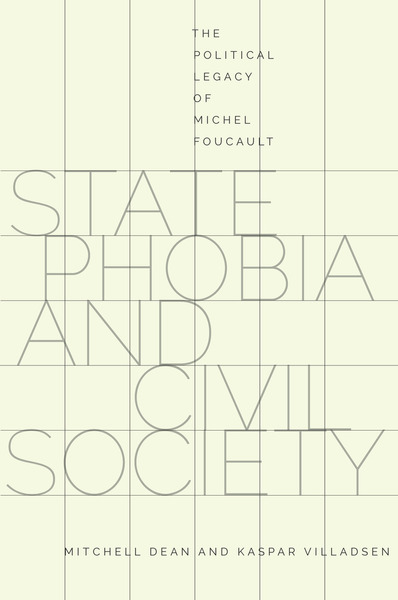
MITCHELL DEAN AND KASPAR VILLADSEN: State Phobia and Civil Society The Political Legacy of Michel Foucault - Stanford University Press, January 2016


State Phobia and Civil Society


The Political Legacy of Michel
Foucault

MITCHELL DEAN AND KASPAR VILLADSEN
State Phobia draws extensively upon the work of Michel Foucault to argue for the necessity of the concept of the state in political and social analysis. In so doing, it takes on not only the dominant view in the human sciences that the concept of the state is outmoded, but also the large interpretative literature on Foucault, which claims that he displaces the state for a de-centered analytics of power. Understanding Foucault means understanding all his interlocutors—whether Marxists, Maoists, neoliberals, or social democrats. It requires turning to Foucault's colleagues, including Deleuze and Guattari, François Ewald, and Blandine Kreigel, in relation to whom he carved out a position. And it entails an examination of his legacy in Hardt and Negri, the theorists of Empire, or in Nikolas Rose, the influential English sociologist. Foucault's own view is highly ambiguous: he claims to be concerned with the exercise of political sovereignty, yet his work cannot make visible the concept of the state. Moving beyond Foucault, the authors outline new ways of conceiving the state's role in establishing social order and in mediating between an inequality-producing capitalist economy and the juridical equality and political rights of individuals. Arguing that states and their cooperation remain of vital importance to resolving contemporary crises, they demonstrate the interdependence of state and civil society and the necessity of social forms of governance.
About the author
Mitchell Dean is Professor of Public Governance at the Copenhagen Business School and Professor of Sociology at the University of Newcastle, Australia. 
Kaspar Villadsen is Associate Professor of Management, Politics, and Philosophy at the Copenhagen Business School.

lunedì 22 dicembre 2014

Foucault, Governmentality, Biopolitics – analytical strategies for critique of power (11 - 13 December 2013) @ Copenahagen Business School


Foucault, Governmentality, Biopolitics – analytical strategies for critique of power 

(11 - 13 December 2013) Copenahagen Business School - Read more @ CBS


FACULTY 
Mitchell Dean, Professor of Public Governance, CBS/University of Newcastle, Australia,
Thomas Dumm, Professor at Department of Political Science, Amherst College, USA.
Jeffrey Busolini, Associate Professor at City University of New York, USA.
Kaspar Villadsen, Associate Professor, Department of Management, Politics & Philosophy, CBS, Denmark.
Marius Gudmand-Høyer, Post.Doc. Scholar, Department of Management, Politics & Philosophy, CBS, Denmark
 
AIM 
The course will provide the participants with:
a) An updated introduction to key analytical concepts in the Governmentality literature, and the potentials and weaknesses of these concepts will be discussed.
b) Possibilities for supplementing the governmentality approach with other analytical sources will be discussed.
c) Furthermore, a detailed consideration of the current status of governmentality studies and post-Foucauldian studies will be given, in particular in light of recent claims for a crisis of critique.
d) Finally, suggestions will be presented on how to elaborate or move beyond the framework of governmentality by activating concepts of bio-power and sovereignty, reconsidering the social and notions of society, and focusing on international dimensions of governmentality.
In brief, the course aims to provide participants with a thorough understanding of the governmentality framework, that is, its analytical possibilities, its current status, and its possible directions of development.
 
INDHOLD 
Over the last 20 years, post-Foucauldian “governmentality studies” have come to growing prominence. These studies have been effective in critically analysing new types of liberal government, in particular by demonstrating ‘the active side of laissez faire’. They describe how the motto of ‘pulling back the state’ has been accompanied by a series of governmental strategies and technologies aimed at shaping institutions and subjects in particular ways. Perhaps most noticeably, they have presented a diagnosis of a proliferation of regimes of enterprise and accounting in new and surprising places. But a wide range of other domains have been subjected to governmentality analysis spanning from genetic screening and risk calculation, new crime prevention strategies, to health promotion by self-responsibilisation. To be sure, the concepts in governmentality studies continue to constitute effective tools for critical social analysis.
Nevertheless, in recent years critical objections have been raised against the governmentality approach. It has been noted by some observers that the Foucauldian and post-structuralist language, originally used for critical academic purposes, seems to be increasingly appropriated by ‘the powers’ that were the object of such critique. Most notably, this point has been voiced (although in different versions) by Zizek, Boltanski, and Hardt & Negri. These thinkers suggest that a post-structural ’politics of difference’ increasingly seems to be an integral part of the ways, in which institutions and companies organise themselves. If modern liberal government has begun to speak for the dissolution of binary essentials, the destabilisation of rigid power structures, the creation of space for the subject’s self-transforming work upon itself, and so on. In light of this development, we need to think of ways to revitalise the Foucauldian concepts of critique/criticism or to push a critical perspective beyond Foucault.
A central theme of the PhD course is the search for effective analytical strategies for critique of power (some perhaps less noticed) in the works of Foucault and other writers within and outside the governmentality tradition. Of particular interest is Giorgio Agamben’s recent critique and extension of Foucault’s genealogy of government.
The course requires the submission of a paper that deals with conceptual problems or analytical designs in relation to Foucauldian inspired/governmentality studies. Furthermore, papers that apply Foucauldian concepts to empirical problems in a variety of domains are welcomed.
It is also possible to participate on the basis of an abstract stating the theme of the PhD project. An abstract should be approximately 1 page, whereas a paper should be approx. 5 pages. In both cases, the PhD student should state his main analytical challenge/concern at his/her current stage in the project.
LECTURE PLAN 
Wednesday 11 December         
10:00-12:30       Kaspar Villadsen: Analytical approaches in governmentality studies  
12:30-13:30       Lunch
         
13:30-16:00       Marius Gudmand-Høyer: Dispositive analysis: the key concept in Foucault?
16:00-17:00       Kaspar Villadsen,  Thomas Dumm, Jeffrey Bussolini & Mitchell Dean: Papers from PhD scholars
  
Thursday 12 December              
10.00-12.30       Thomas Dumm: Foucault, neo-liberalism and freedom
12:30-13:30       Lunch
      
13.30-15.00       Mitchell Dean: Concepts of power: ‘The signature of power’
  
15.00-17.00       Kaspar Villadsen, Thomas Dumm, Jeffrey Bussolini & Mitchell Dean: Papers from PhD scholars  
Friday 13 December                 
10:00-11:15       Jeffrey Busoloni: Biopolitics: Foucault meets Agamben
11:30-12:30       Mitchell Dean: Governmentality meets theology
12.30-13.30       Lunch   
     
13:30-15:00       Kaspar Villadsen: Technologies and organisations in Foucault’s thinking
  
15.00-16.00       Kaspar Villadsen, Jeffrey Busolini, Thomas Dumm, Marius Gudmand-Høyer & Mitchell Dean: Papers from PhD scholars
16:00-17:00       Kaspar Villadsen & Mitchell Dean: Concluding discussion and evaluation  

COURSE LITERATURE 
Agamben, G. (2011) The Kingdom and the Glory: a Theological Genealogy of Economy and Government. Stanford University Press (especially pages 109-114; Appendix; not provided by the CBS).
Bussolini, J. (2010) ’What is a dispositive?’, Foucault Studies, No. 10, pp. 85-107
Dean, M. (2012) ‘Governmentality meets theology: the king reigns but does not govern’, Theory, Culture and Society, 29(3): 145-58.
Dean, M. (2012) ‘Economies of Power’, in M. Dean: The Signature of Power. London: Sage (p. 45-69).
Dumm, T. (2007) ’Freedom and Space’, in T. Dumm: Foucault and the Politics of Freedom. Oxford: Rowman and Littlefield Publishers (p. 29-69).
Foucault, M. (2007) Security, Territory, Population. New York: Palgrave Macmillan (especially lecture 1 and 5; only 5 is provided by the CBS)
Foucault, M. (2008) The Birth of Biopolitics. New York: Palgrave Macmillan (especially lecture 12).
Villadsen, K. & Karlsen, M.P. (2008) ’Who Should Do the Talking? The proliferation of dialogue as governmental technology’, Culture & Organization, 14(4).
Villadsen, K. (2008) "Doing without the State and Civil Society as Universals: 'Dispositifs' of care across the classic sector divide", Journal of Civil Society, 4(3).
 

Foucault, Governmentality, Context: Contextualised analysis power (27 - 29 October 2014) @ CBS - Copenhagen Business School


Foucault, Governmentality, Context: Contextualised analysis power 
( 27 - 29 October 2014 ) @ CBS - Copenhagen Business School

FACULTY 
Mitchell Dean, Professor of Public Governance, CBS/University of Newcastle, Australia,

Michael Behrent, Assistant Professor, Department of History, Appalachian State University

Kaspar Villadsen, Associate Professor, Department of Management, Politics & Philosophy, CBS, Denmark.

Marius Gudmand-Høyer, Post.Doc. Scholar, Department of Management, Politics & Philosophy, CBS, Denmark.

Mads Peter Karlsen, Post.Doc., Institute of Theology, Copenhagen University.
AIM 
The course will provide the participants with:

a) An updated introduction to key analytical concepts in the Governmentality literature, and the potentials and weaknesses of these concepts will be discussed.

b) Possibilities for supplementing the governmentality approach with other analytical sources will be discussed.

c) Furthermore, a detailed consideration of the current status of governmentality studies and post-Foucauldian studies will be given, in particular in light of recent claims for a crisis of critique.

d) Finally, suggestions will be presented on how to elaborate or move beyond the framework of governmentality by activating concepts of bio-power and sovereignty, reconsidering the social and notions of society, and focusing on international dimensions of governmentality.

In brief, the course aims to provide participants with a thorough understanding of the governmentality framework, that is, its analytical possibilities, its current status, and its possible directions of development.
INDHOLD 
Over the last 20 years, post-Foucauldian “governmentality studies” have come to growing prominence. These studies have been effective in critically analysing new types of liberal government, in particular by demonstrating ‘the active side of laissez faire’. They describe how the motto of ‘pulling back the state’ has been accompanied by a series of governmental strategies and technologies aimed at shaping institutions and subjects in particular ways. Perhaps most noticeably, they have presented a diagnosis of a proliferation of regimes of enterprise and accounting in new and surprising places. But a wide range of other domains have been subjected to governmentality analysis spanning from genetic screening and risk calculation, new crime prevention strategies, to health promotion by self-responsibilisation. To be sure, the concepts in governmentality studies continue to constitute effective tools for critical social analysis.

Nevertheless, in recent years critical objections have been raised against the governmentality approach. It has been noted by some observers that the Foucauldian and post-structuralist language, originally used for critical academic purposes, seems to be increasingly appropriated by ‘the powers’ that were the object of such critique. Most notably, this point has been voiced (although in different versions) by Zizek, Boltanski, and Hardt & Negri. These thinkers suggest that a post-structural ’politics of difference’ increasingly seems to be an integral part of the ways, in which institutions and companies organise themselves. If modern liberal government has begun to speak for the dissolution of binary essentials, the destabilisation of rigid power structures, the creation of space for the subject’s self-transforming work upon itself, and so on. In light of this development, we need to think of ways to revitalise the Foucauldian concepts of critique/criticism or to push a critical perspective beyond Foucault. A central theme of the PhD course is the search for effective analytical strategies for critique of power (some perhaps less noticed) in the works of Foucault and other writers within and outside the governmentality tradition.

The course gives importance to the need for contextualizing both the concepts that we use for making analysis, both in terms of being aware of how concepts emerge in a particular historical-political context that shape them. We shall hence discuss how to do intellectual history on recent thinkers, including Foucault himself. Foucault's most intensive reflection on political questions was in the 1970s.  Given that the key source of his reflections here are lectures and interviews, we should attend to this reflection less as elaborated theory and more as a kind of performance in a definite context with specific interlocutors. A Foucault very different from his Anglo-American decontextualized reception as a theorist of omnipresent micropowers emerges if we do so. There are of contemporary events and political currents: European terrorism, state socialism, French Maoism, the Iranian Revolution, the prospects of a Socialist government in France, etc. But there are specific interlocutors including his assistants (Kreigel, Ewald), seminar participants (Pasquino, Procacci, Rosanvallon), colleagues (Donzelot, Castel, Deleuze), auditors, political fractions such as the Second Left and Italian autonomist Marxists.  If statements should be read in terms of what they do as much as what they mean, then the diverse trajectories of these thinkers are also relevant to reading Foucault's political thought.

The course requires the submission of a paper that deals with conceptual problems or analytical designs in relation to Foucauldian inspired/governmentality studies. Furthermore, papers that apply Foucauldian concepts to empirical problems in a variety of domains are welcomed. It is also possible to participate on the basis of an abstract stating the theme of the PhD project. An abstract should be approximately 1 page, whereas a paper should be approx. 5 pages. In both cases, the PhD student should state his main analytical challenge/concern at his/her current stage in the project.

LECTURE PLAN 
Monday 27 October               
10:00-12:30: Kaspar Villadsen: Analytical approaches in governmentality studies    

12:30-13:30: Lunch          

13:30-16:00: Mitchell Dean: Concepts and signatures of power in Foucualt

16:00-17:00: Kaspar Villadsen & Mitchell Dean: Papers from PhD scholars
   
Tuesday 28 October                
10.00-12.30: Michael Behrent: Foucault and the context for his thought on power.

12:30-13:30: Lunch
          
13.30-15.00: Kaspar Villadsen: Technologies and organisations in Foucault
   
15.00-17.00: Kaspar Villadsen, Michael Behrent & Mitchell Dean: Papers from PhD scholars   

Wednesday 29 October                  
10:00-11:30: Mads P. Karlsen: Foucault’s Maoist militancy

11:00-12:30: Mitchell Dean: Foucault and neoliberalism

12.30-13.30: Lunch          

13:30-15:00: Marius Gudmand-Høyer: Dispositive analysis: the key concept in Foucault?   

15.00-16.00: Kaspar Villadsen, Mitchell Dean, Michael Behrent: Papers from PhD scholars   

16:00-17:00: Kaspar Villadsen & Mitchell Dean: Concluding discussion and evaluation   
 
COURSE LITERATURE 
Behrent, M. (2009) “Liberalism Without Humanism: Foucault and the Free Market Creed”, Modern Intellectual History, 6: 539-568.

Behrent, M. (2010) “Accidents happens: François Ewald, the ‘antirevolutionary Foucault”, and the intellectual politics of the French welfare state”, Journal of Modern History 82 (3): 585-624.

Dean, M. (2013) The Signature of Power: sovereignty, governmentality and biopolitics. Sage: London, chapters 2.3.4.

Dean, M. (2014) “Rethinking neoliberalism”, Journal of Sociology 50 (2): 150-163.

Dean, M. (2010) Governmentality: Power and Rule in Modern Societies (2nd edition). London: Sage (especially Introduction to Second Edition and chapter 1).

Foucault, M. (2007) Security, Territory, Population. New York: Palgrave Macmillan (especially lecture 1 & 5).

Foucault, M. (2008) The Birth of Biopolitics. New York: Palgrave Macmillan (especially lecture 12).

Deleuze, G. (1990) “Postscript on Control Societies”, in: G. Deleuze: Negotiations 1972-1990. New York: Columbia University Press

Karlsen, M.P. & Villadsen, K. & (2008) "Who Should Do the Talking? The proliferation of dialogue as governmental technology", Culture & Organization, 14(4).

Karlsen, M.P. & Villadsen, K. (2014) “Investigate ‘The Intolerable’: Foucault’s Maoist inspirations”, New Political Science (forthcoming).

Mirowski, P. (2012) Never Let a Serious Crisis Go to Waste: how neoliberalism survived the financial meltdown. London: Verso, chs 2, 3.

Raffnsøe, S. & Gudmand-Høyer, M. The Dispositive, Unpublished article.

Villadsen, K. (2011) “Modern Welfare and ‘Good Old’ Philanthropy”, Public Management Review, 13(8): 1057–1075.
 

domenica 21 dicembre 2014

Mitchell Dean: Foucault's "apology" for neoliberalism @ British Library, 25th June 2014. “Remembering Foucault” on the occasion of the 30th anniversary of the death of Michel Foucault, organized by Department of Law, LSE.


Michel Foucault’s “apology” for neoliberalism
Mitchell Dean, CBS.
British Library, 25th June 2014. “Remembering Foucault” on the occasion of the 30th anniversary of the death of Michel Foucault, organized by Department of Law, LSE.


  • The title of my talk is “Michel Foucault’s ‘apology’ for neoliberalism”. I know it’s a bit provocative. The word “apology” is in inverted commas, so that is acceptable; but the phrase “apology for neoliberalism” slightly misquotes the words of perhaps his closest and most influential follower. Nevertheless, on this evening, the thirtieth anniversary of his death, I want to raise the question of Foucault’s critical and political legacy given his status today as among the most influential thinkers in the contemporary human and social sciences. What is at stake is less Foucault himself than ourselves in a time of the active withdrawal of the critical vocation of these sciences, in which the vocabulary of power would itself be suspect and replaced by the idiom of governance, and in which empirical analysis is encouraged but narrowed. In our universities, academic quality has become increasingly measurable in monetary terms. Certainly a cool and contextualized investigation of the case for this apology is warranted. But so too would be a thinking beyond Foucault, or at least to a place that is necessarily somewhat different from his – to move laterally like a crayfish as he put it (2008, 78).

On the 9th of May, 2012, at the University of Chicago François Ewald found himself in a seminar in the presence of Gary Becker, the Chicago economist whose work Foucault addressed in several lectures of The Birth of Biopolitics in 1979. Ewald described these lectures as the place “where he (Foucault) made the apology of neoliberalism – especially the apology of Gary Becker, who is referred to...as the most radical representative of American neoliberalism” (Ewald in Becker et al 2012, 4). Ewald it must be said spoke here with some authority. He completed his doctorate on the Welfare State under Foucault and he has the honor of being directly referred to in these lectures. He was his personal assistant at the Collège de France. He would co-edit Foucault shorter pieces (Dits et Ecrits) and act as general editor for the recent publication of his lectures at the Collège. Yet he is something of a problematic figure for those on the Left: a “right Foucauldian” (Negri 2001) who would promote the “policies and mechanisms for...reconstructing society according to neoliberal principles” first revealed to him in Foucault’s lectures (Lazzarato 2009, 110). Ewald had been a militant Maoist who would enlist Foucault in 1972 in what became known as L’Affaire Bruay – the dubious politics surrounding the still unsolved murder of the teenaged daughter of a mining family in northern France. He would nevertheless receive the Legion of Honour in 2006 for his services for the employers association, Medef. These included the break-up of corporatist arrangements between employers, unions and the state, and the introduction of direct contractual negotiations, in what amounted to a self-styled “coup of civil society against the state” at the time of the premiership of Lionel Jospin (Behrent 2010, 619).

In Chicago, Ewald would claim that Foucault offered an “apology of neoliberalism” and an “apology of Gary Becker”. Even allowing for language difficulties, perhaps he meant less “an apology for” than “an apologia of” neoliberalism and Becker, that is, Foucault offered a form of public defense of them, of their relevance against those who would otherwise dismiss or denounce them. In fact Ewald’s appraisal is even more positive than this. After discussing the post-68 situation, he suggests Foucault answered the demand for a theory of the state with the notion of governmentality within which economists would act as “truth-tellers” in relation to government. Foucault, he suggests, was searching for non-moral and non-juridical theory and he found it in the economists. “That is the celebration of the economists’ work, of your work” he said to Gary Becker (Ewald in Becker et al. 2012, 5). Ewald counseled Becker that Foucault discovered in him the “possibility of thinking about power without discipline” and thus “to conduct the behavior of the other without coercion, by incitation” (Ewald in Becker et al. 2012, 6). And there is no doubt that Ewald means all of this in an extremely complimentary way when he concludes this address with respect to Foucault’s views: “Certain kinds of truth-telling are death for liberty, other kinds of truth-telling give new possibilities for liberty. And he sees your work, your kind of analyses as creating the possibility to promote, to envision new kinds of liberty”. Ewald would even go so far as to clam that the idea of homo œconomicus contained in Becker’s theory was decisive in the movement of Foucault’s thought between “his earlier theory of power” and his later “lectures about subjectivity” (ibid, p. 7). (...)


Read more @ Journal of Political Power Volume 7, Issue 3, 2014

sabato 26 novembre 2011

Mitchell Dean - Governmentality. Power and Rule in Modern Society (Sage Publications, January 2010)


Originally published in 1999 this exceptionally clear and lucid book quickly became the standard overview of what are now called ‘governmentality studies’.
With its emphasis on the relationship between governmentality and other key concepts drawn from Michel Foucault, such as bio-politics and sovereignty, the First Edition anticipated and defined the terms of contemporary debate and analysis.
In this timely Second Edition, Mitchell Dean engages with the full textual basis of Foucault’s lecturers and once again provides invaluable insights into the traditions, methods, and theories of political power identifying the authoritarian as well as liberal sides of governmentality.
Every chapter has been fully revised and updated to incorporate, and respond to, new theoretical, social and political developments in the field; a new introduction surveying the state of governmentality today has also been added as well as a completely new chapter on international governmentality.