Visualizzazione post con etichetta Riviste specializzate. Mostra tutti i post

venerdì 20 dicembre 2013

Aut Aut n.360/2013: All’indice. Critica della cultura della valutazione


a cura di Alessandro Dal Lago
Alessandro Dal Lago Premessa. La (s)valutazione della ricerca
Valeria Pinto La valutazione come strumento di intelligence e tecnologia di governo
Antonio Banfi, Giuseppe De Nicolao Valutare senza sapere. Come salvare la valutazione della ricerca in Italia da chi pretende di usarla senza conoscerla
Claudio La Rocca Commisurare la ricerca. Piccola teleologia della neovalutazione
Francesca Coin La valutazione dell’utilità e l’utilità della valutazione
Francesco Sylos Labini Una nota su valutazione e conformismo
Roberto Ciccarelli La bolla formativa è esplosa. Educazione, disciplinamento e crisi del soggetto imprenditore
Massimiliano Nicoli Come le falene. Precarietà e pratica della filosofia
MATERIALI
Michel Foucault
 Che cos’è un regime di verità? [1980]
INTERVENTI
Mario Novello
 Diagnosi psichiatrica e giustizia

domenica 22 settembre 2013

Le militantisme en psychiatrie – Sud/Nord 25/2013


militantisme-psychiatrie


Présentation
“L’évolution de la psychiatrie, le progrès dans l’accueil des malades et dans le soutien qui leur est apporté sont historiquement indissociables d’un certain engagement éthique et politique des soignants en psychiatrie, d’une certaine valeur accordée à la dignité humaine et d’un combat contre ce qui dévalorise l’homme.”
Jacques Hochmann
Les maladies mentales, plus que toute autre maladie humaine, sont sources de stigmatisation, de rejet social, de mépris, de mauvais traitements et de peur. Et ce d’autant plus que, dans la grande majorité des cas, on ignore encore aujourd’hui l’origine exacte de ces troubles, ce qui laisse livre cours à toutes les théories explicatives, y compris les plus hasardeuses.
Dans une société où la démocratie recule et où la subjectivité de chacun est réduite au statut d’entrepreneur de soi-même en compétition avec les autres, la psychiatrie se réduit-elle « au service du nouvel ordre économique » ? Le militantisme n’a pas disparu. Il anime en particulier les associations de patients et, parfois de manière très offensive, des associations de familles, ainsi que tous ceux, confrontés à la précarité qui se préoccupent, dans une perspective de santé mentale, des nouvelles souffrances sociales engendrées par la crise économique, la paupérisation et la migration… (suite)
Sommaire
Michel MinardEdmond Perrier, Éditorial …………………………………………… 7
Jacques Hochmann, Du militantisme en psychiatrie ………………………………. 9
Isabelle von Bueltzingsloewen, Le militantisme en psychiatrie,
de la Libération à nos jours. Quelle histoire ?! ………………………… 13
Mario Colucci, Le scandale Basaglia ……………………………………………………. 27
François Gonon, Cinquante ans de psychiatrie biologique
De l’espoir au doute assumé, Édouard Zarifian et
Elliot Valenstein, militants exemplaires …………………………………………. 39
Patrick Faugeras, Michel Minard, Portrait d’un militant,
François Tosquelles ……………………………………………………………. 49
Olivier Labouret, Ramer à contre-courant : les combats d’aujourd’hui
dans le service public de psychiatrie ……………………………………… 57
Christian Laval, Entre militantisme et engagement en santé mentale ………. 67
Brigitte Chamak, Le militantisme des associations d’usagers et de familles :
l’exemple de l’autisme ………………………………………………………… 71
Alain Castéra, Pour une analyse de la situation …………………………………….. 816
Pierangelo Di Vittorio, Gestion ou révolution. L’expérience
de Franco Basaglia, entre critique et politique ………………………… 85
Dimitri Karavokyros, Le rôle du Syndicat des médecins des
hôpitaux psychiatriques dans la mise en place du secteur …………. 97
Jean-Noël Missa, Peut-on parler de militantisme psychopharmacologique
chez les pionniers de la psychiatrie biologique (1952-1960) ? …… 105
Anne-Marie Leyreloup, Entre hier et aujourd’hui,
le métier d’infirmier en psychiatrie ………………………………………. 121
Patrick Faugeras, Les murs de l’asile
À propos de Roger Gentis ………………………………………………………… 129
Marcel Sassolas, Pour quelle psychiatrie militer ? …………………………………… 139
Nicole Rumeau, Francis Jeanson, un mécréant qui s’est mêlé de psychiatrie 151

giovedì 19 settembre 2013

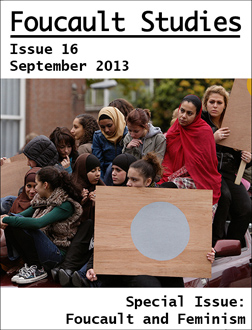
Foucault Studies: Issue 16 - September 2013 / Special Issue: Foucault and Feminism


Number 16: September 2013: Foucault and Feminism

Table of Contents

Editorial
       
Sverre Raffnsøe, Alain Beaulieu, Sam Binkley, Patricia Clough, Sven Opitz, Jyoti Puri, Jens Erik Kristensen, Alan Rosenberg, Marius Gudmand-Høyer & Ditte Vilstrup Holm
____________________________________________

Special Issue on Foucault and Feminism

Foucault Studies Special Issue: Foucault and Feminism, September 2013
        Cressida J. Heyes
Feminism, Foucault and the Critique of Reason: Re-reading the History of Madness
         Amy Allen
Feminism and Neoliberal Governmentality
        Johanna Oksala
Post-liberation Feminism and Practices of Freedom
        Ladelle McWhorter
Queer Feminism: Cultivating Ethical Practices of Freedom
        Jana Sawicki
Resisting the Subject: A Feminist-Foucauldian Approach to Cfountering Sexual Violence
        Dianna Taylor____________________________________________
Translations
Machiavelli Facing the Challenge of Gouvernementalité
        Michel Senellart___________________________________________

Articles
Force and Knowledge: Foucault’s Reading of Nietzsche
        Kojiro Fujita
Foucault and Althusser: Epistemological Differences with Political Effects
        Andrew Ryder
Stultitia and Type 2 Diabetes: The Madness of Not Wanting to Care for the Self
        Anders Kruse Ljungdalh
_____________________________________________________

Reviews
Colin Koopman (ed.)“Special issue: Foucault across the disciplines,” History of Human Sciences, vol. 24. no. 4, October (2011)
        Michael Solda
Éric Alliez and Andrew Goffey (eds.)The Guattari Effect (London & New York: Continuum, 2011)
        Jonathan Fardy
Krzysztof MichalskiThe Flame of Eternity: An Interpretation of Nietzsche’s Thought (Princeton: Princeton University Press, 2012)
        Apple Zefelius Igrek
Philippe ChevalierMichel Foucault et le christianisme (Lyon: ENS Éditions, 2011)
        Michael Maidan
Saba MahmoodPolitics of Piety: The Islamic Revival and the Feminist Subject (Princeton: Princeton University Press, 2011)
        Michele Spanò
David L. HildebrandDewey: A Beginner’s Guide (Oxford: Oneworld Publications, 2008)
        Kathleen Cole
Noam Chomsky and Michel FoucaultHuman Nature: Justice vs Power, The Chomsky-Foucault Debate, edited by Fons Elders (London: Souvenir Press, 2011)
        Asger Sørensen
Ian MarshSuicide: Foucault, History and Truth (Cambridge: Cambridge University Press, 2010)
         Daniel R. Mistich
David Pettigrew & Francois Raffoul (eds.)French Interpretations of Heidegger: An Exceptional Reception (State University of New York Press, 2008) & Isabelle GaroFoucault, Deleuze, Althusser et Marx – La politique dans la philosophie (Demopolis, 2011)
            Andrew Ryder
John M. CooperPursuits of Wisdom: Six Ways of Life in Ancient Philosophy from Socrates to Plotinus (Princeton: Princeton University Press, 2012)
        Joel Alden Schlosser

mercoledì 26 ottobre 2011

ECONOMY AND SOCIETY Michel Foucault and Governmentality

In the past twenty years Economy and Society has been decisive in developing Michel Foucault’s analyses 
of ‘governmentality’, pressing this concept into service in new domains. In a wide range of articles written from 
diverse disciplinary backgrounds, scholars have clarified the conceptual vocabulary and empirical vitality of the 
notion of ‘the conduct of conduct’ for political and social analysis. In addition to a special issue dedicated to this 
theme (‘Liberalism, Neo-Liberalism and Governmentality’ 22.3, 1993), there has been debate about the 
relationships that may pertain between liberal government, despotism and authoritarianism (Valverde 1996, 
Dean 2001), consideration of the ways in which Foucault’s conceptual vocabulary can help to reframe 
key problems in political theory (Burchell 1993, Hunter 1990, Hindess 1997, Pasquino 1993), analysis 
of the implications of Foucault’s work for the methodological assumptions of the human sciences, 
and for the analysis of the social, including the government of diverse fields such as health, 
poverty, unemployment, policing, risk, and ethical conduct (Osborne 1993, Rose 1996, Dean 1992, O’Malley 1992, Cruikshank 1993).  The journal has housed debate about the significance of governmentality outside western liberal  
contexts (eg Sigley 1996, Keane 2002), and concerning the transformations of government produced by new 
technologies of warfare and welfare (Donzelot 2008, O’Malley 2010). 


Governing economic life  
Peter Miller and Nikolas Rose, Volume 19, Issue 1, 1990 
A genealogy of the government of poverty 
Mitchell Dean, Volume 21, Issue 3, 1992 
Risk, power and crime prevention 
Pat O'Malley, Volume 21, Issue 3, 1992 
Liberal government and techniques of the self 
Graham Burchell, Volume 22, Issue 3, 1993 
Revolutions within: self-government and self-esteem 
Barbara Cruikshank, Volume 22, Issue 3, 1993 
The death of the social? Re-figuring the territory of government 
Nikolas Rose, Volume 25, Issue 3, 1996 
"Despotism " and ethical liberal governance 
Mariana Valverde, Volume 25, Issue 3,1996 
Politics and governmentality 
Barry Hindess, Volume 26, Issue 2, 1997 
Governing through risk and uncertainty 
Richard Ericson, Volume 34, Issue 4, 2005 
Michel Foucault and liberal intelligence 
Jacques Donzelot (translated by Graham Burchell), Volume 37, Issue 1, 2008 


lunedì 24 ottobre 2011

Foucault Studies

Foucault Studies is pleased to announce the publication of issue 12

A Special Issue on Foucault and Race

Guest Edited by Ladelle McWhorter

Issue 12 also includes:

A translated interview with Denys Foucault
An interview with Cressida J. Heyes
Three original articles related to Foucault’s writings on neoliberalism
and eight book reviews
Foucault Studies is an electronic, open access, peer reviewed, international journal that provides a forum for scholarship engaging the intellectual legacy of Michel Foucault, interpreted in the broadest possible terms. We welcome submissions ranging from theoretical explications of Foucault’s work and texts to interdisciplinary engagements across various fields, to empirical studies of contemporary phenomena using Foucaultian frameworks.

All articles are freely available as open access on the journal website

Please visit the website to sign up for E-alerts to receive news of CFPs and new issues.
Number 12, October 2011: Foucault and Race
Table of Contents

Editorial

Sverre Raffnsøe, Alan Rosenberg, Alain Beaulieu, Sam Binkley, Sven Opitz, Chloë Taylor, Jens Erik Kristensen, Ditte Vilstrup Holm
_________________________________________________________________________________________
Special Issue on Foucault and Race

Guest Editor’s Introduction

Ladelle McWhorter

Toward a Foucaultian Epistemology of Resistance: Counter-Memory, Epistemic Friction, and Guerrilla Pluralism

José Medina

The Down Low and the Sexuality of Race

Brad Elliott Stone

The War on Terror and Ontopolitics: Concerns with Foucault’s Account of Race, Power Sovereignty

Falguni A. Sheth

Decapitating Power

Ladelle McWhorter

Modern Living and Vital Race: Foucault and the Science of Life

Mary Beth Mader
______________________________________________________________________________________
Interviews

Changing the Subject

Cressida J. Heyes, Michael McGarry

Born to Learn

Denys Foucault, Jean-Luc Terradillos,
__________________________________________________________________________________________
Articles

From ‘Entrepreneur of the Self’ to ‘Care of the Self’: Neo-liberal Governmentality and Foucault’s Ethics

Andrew Dilts

Welfare and Foreign Aid Practices in the Contemporary United States: a Governmental Study

Philippe Fournier

The Biopolitics of Ordoliberalism

Thomas Biebricher
___________________________________________________________________________________________
Reviews

David Konstan, Before Forgiveness: The Origins of a Moral Idea (Cambridge: Cambridge University Press, 2010)

Brendan Boyle

Judith Butler, Giving an Account of Oneself (New York: Fordham University Press, 2005)

Sylvia Morin

Philippe Artières, Jean-François Bert, Frédéric Gros and Judith Revel (eds.), Cahier de L’Herne 95: Michel Foucault (Paris: L’Herne, 2011)

Benoît Dillet

Frédéric Gros, States of Violence: An Essay on the End of War (London: Seagull Books, 2010)

Apple Zefelius Igrek

Philippe Artières, Jean-François Bert, Philippe Chevallier, Pascal Michon, Mathieu Potte-Bonneville, Judith Revel and Jean-Claude Zancarini (textes choisis et présentés par), Les mots et les choses de Foucault. Regards critiques 1966-1968 (Caen: Presses Universitaires de Caen, 2009)

Elisabetta Basso

Simon O’Sullivan and Stephen Zepke (eds.), Deleuze, Guattari, and the Production of the New (London: Continuum, 2008)

Ricky Crano

Ben Golder and Peter Fitzpatrick (eds.), Foucault and Law (Surrey and Burlington: Ashgate, 2010)

Verena Erlenbusch

Magnus Hörnqvist, Risk, Power and the State: After Foucault (Abingdon, UK: Routledge, 2010)

Donald Beggs

Sergey Dolgopolski, What Is Talmud? The Art of Disagreement (New York: Fordham University Press, 2009)

Alan Milchman, Alan Rosenberg

History of the Human Sciences - October 2011, 24 (4)


Colin Koopman
Foucault across the disciplines: introductory notes on contingency in critical inquiry
           Abstract:Foucault is one of the most widely cited thinkers across social sciences and humanities disciplines today. Foucault’s appeal, and ongoing value, across the disciplines has much to do with the power of his thought and his method to help us see the contingency of practices we take to be inevitable. It is argued in this introductory article that Foucault’s emphasis on contingency is as misunderstood as it is influential. I distinguish two senses of contingency in Foucault. A first sense, widely acknowledged, concerns Foucault’s facility at showing that a taken-for-natural practice is in fact contingently produced. A second sense, widely neglected, concerns the facility of Foucauldian methods for grasping how a given practice was contingently produced. The second sense of contingency opens up possibilities for practical transformation that the former sense of contingency largely leaves to the side.

Ian Hacking
Déraison

Arnold I. Davidson
In praise of counter-conduct

Amy Allen
Foucault and the politics of our selves

James Ferguson
Toward a left art of government: from ‘Foucauldian critique’ to
 Foucauldian politics

Hans Sluga
“‘Could you define the sense you give the word “political”’? Michel
 Foucault as a political philosopher

Mark Bevir
Political science after Foucault

Mark Franko
Archaeological choreographic practices: Foucault and Forsythe

Catherine M. Soussloff
Foucault on painting