Visualizzazione post con etichetta Zamora. Mostra tutti i post

lunedì 30 novembre 2015

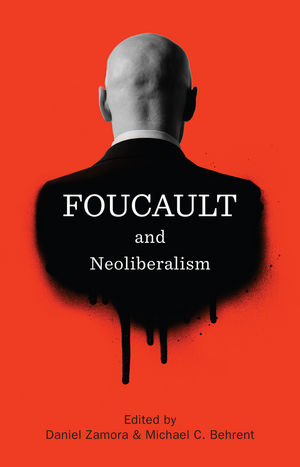
Daniel Zamora & Michael C. Behrent - Foucault and Neoliberalism @ Polity Press, November 2015


Foucault and Neoliberalism

Michel Foucault's death in 1984 coincided with the fading away of the hopes for social transformation that characterized the postwar period. In the decades following his death, neoliberalism has triumphed and attacks on social rights have become increasingly bold. If Foucault was not a direct witness of these years, his work on neoliberalism is nonetheless prescient: the question of liberalism occupies an important place in his last works. Since his death, Foucault's conceptual apparatus has acquired a central, even dominant position for a substantial segment of the world's intellectual left.

However, as the contributions to this volume demonstrate, Foucault's attitude towards neoliberalism was at least equivocal. Far from leading an intellectual struggle against free market orthodoxy, Foucault seems in many ways to endorse it. How is one to understand his radical critique of the welfare state, understood as an instrument of biopower? Or his support for the pandering anti-Marxism of the so-called new philosophers ? Is it possible that Foucault was seduced by neoliberalism?

This question is not merely of biographical interest: it forces us to confront more generally the mutations of the left since May 1968, the disillusionment of the years that followed and the profound transformations in the French intellectual field over the past thirty years. To understand the 1980s and the neoliberal triumph is to explore the most ambiguous corners of the intellectual left through one of its most important figures.

DANIEL ZAMORA is a PhD candidate at the Free University of Brussels and his work on Foucault has been widely published.
MICHAEL C. BEHRENT is Associate Professor at Appalachian State University.


Reviews


"In recent years, Michel Foucault has garnered a reputation as a fierce critic of the neoliberal order, especially through his analyses of micro-politics and governmentality. But the essays in this terrific collection raise important questions about Foucault s relation to neoliberalism. They show that Foucault himself was quite sympathetic to some of its core elements, and, more importantly, that his theory has in many ways diluted the intellectual resources that might enable more successful resistance to it. The book is a must-read for anyone interested in critical social theory and in contemporary political culture."
Vivek Chibber, New York University


Michel Foucault was a far-sighted theorist, but also a creature of his time. This superlative collection moves beyond early polemics in order to force reflection on the uses and limits of the great philosopher s now celebrated investigation of neoliberalism in part by providing a reminder of how it fit in the various contexts of French intellectual life in the 1970s that informed it. Michael Behrent and Daniel Zamora deserve credit for offering precautions, rather than burning Foucault, as the next stage of his reception unfolds.
Samuel Moyn, Harvard University

The antistatist turn of much of the global left has disturbing but largely unexamined affinities with neoliberalism. Michel Foucault, for all his greatness, is a key figure in this turn. This collection is a stimulating exploration of those affinities, and, to put it provocatively, but not inaccurately, Foucault's commonalities with the likes of Gary Becker and Friedrich Hayek. This excellent book will annoy many, but it has the potential, for those with sufficiently open minds, of being a productive annoyance.
Doug Henwood, The Nation


Foucault and Neoliberalism has already begun to launch a crucial historical and political debate. Its critique and historical contextualization of Foucault s late work open up new perspectives on the rise of neoliberalism in France and the general evolution of the intellectual left since the 1980s. From the retreat of class analysis to the triumph both of identity politics and of a conception of social justice limited to equality of opportunity, Foucault and Neoliberalism helps us first to understand and then to imagine an alternative to the political dead end of the contemporary left.
Walter Benn Michaels, University of Illinois at Chicago

martedì 6 gennaio 2015

Daniel Zamora and Foucault and Neoliberalism AUFS Event: Daniel Zamora – A Reply: Was Foucault Speaking in His Own Voice? @ AUFS blog, 06Jan2014


Foucault and Neoliberalism AUFS Event: 
Daniel Zamora – A Reply: Was Foucault Speaking in His Own Voice?
Daniel Zamora is a doctoral candidate in Sociology at the Université Libre de Bruxelles. Later in 2015, a translation of Critiquer Foucault: Les années 1980 et la tentation néolibérale will appear in English. Two recent discussions by Zamora on Foucault and Neoliberalism can be found at Jacobin.

First I would like to thank the four contributors and AUFS for devoting this series to the theme of Foucault and neoliberalism. All the interventions are highly stimulating and take us to the heart of a debate of great current moment. Obviously I am not able to undertake a general discussion of all the interventions and all the central questions they pose. But I am sure that the debate will not end here, that it will continue when the book is published in English. However, I would like to revisit the reasoning behind my argument, and why I do not think that it is a problem of interpreting Foucault’s words.
It is indeed true, as Stuart Elden notes in his response, that “Foucault’s mode of reading texts often makes it look like he is agreeing with arguments, when he is really trying to reconstruct them, to understand their logic, and so on.” Verena Erlenbusch, for her part, adds that I “[fail] to recognize that Foucault is not speaking in his own voice but paraphrasing important representatives of neoliberal thought.” The argument made by Stuart Elden clearly applies to Foucault’s lectures at the Collège de France. But while I am largely in agreement with his critique, I do not think it affects my argument. This is the case for two reasons.
First, because my argument is only secondarily based on Foucault’s lectures. Indeed, of the 45 footnotes citing Foucault in my text [in Critiquer Foucault], only 9 come from the lectures he delivered at the Collège de France. The other 36 are from texts, interviews, and interventions that he delivered over a period stretching from 1972 to 1983. Thus, when Foucault takes aim at the notion of a “right to health,” in terms that are ambiguous to say the least, or when he invokes the “perverse” effects of social security, he is responding to a national secretary of the CFDT [the French union federation] in one of the rare interviews that he devoted to this subject. To this, Verena Erlenbusch replies that “with regard to the interviews Foucault gave, it seems to me by no means necessary that Foucault always speaks in his own voice.” But on what basis can she claim this? Why, in this interview given in 1983, in which absolutely nothing indicates he was not speaking in his own name, should I think this is the case? And if it is the case, should we then conclude that there is no interview where Foucault ever gave his own opinion? If this were the case, it would be necessary to revise the great majority of the existing studies of Foucault.
The truth is much simpler: the person interviewing Foucault is very clearly addressing him and soliciting his opinion, using terms such as “do you think”, “in your opinion,” “is it your view that,” “do you support the goal I’ve just outlined?” Foucault is speaking in his own name; it is necessary to accept this and to try to understand why he thinks such things. The same goes for all the other interviews where he takes up neoliberal arguments in his own words and speaks in his own name. Understanding Foucault means above all to read him honestly, not to attribute to him the opinions that suit us and to ignore those we don’t like. As Michael Behrent notes, “the real danger consists in turning Foucault into our fantasy philosopher, the thinker we want him to be—an unrelenting critic of Marxism who somehow remained a kind of socialist; a Nietzschean who embraced solid progressive principles. This is just wishful thinking. Historicizing, in this instance, is the best form of critique.”
Second, I do not think we can exempt from discussion the texts of the Collège de France lectures. The least that can be said is that they are ambiguous, and that what he is saying in them is a matter of debate. In addition, the argument I make about Soléru’s negative income tax is based on a more general theoretical discussion about the shift from exploitation to exclusion, and towards those on the “margins” of the workforce. These two shifts – the end of the political centrality of the working class and the notion of exploitation – constitute, in my view, two of the principal theoretical evolutions that accompanied the advent of neoliberalism. And it cannot be denied that, on these two planes, in his books as well as his texts and interviews, Foucault participates in this evolution. Certainly all of this is complicated and demands much more thorough discussion. But I think that today these questions are quite pertinent and absolutely necessary.
Thus, to the criticism that this isn’t the “right question,” I would respond, on the contrary, that it is precisely the right question. The neoliberal offensive profoundly reconfigured the intellectual field of the 1970s, and to better oppose it we must understand its origins. In this sense, my response would take the form of that which Foucault gave to Chomsky concerning anarcho-syndicalism. In our haste to oppose neoliberalism, without first understanding the profound revolution of which it is the product, we risk perpetuating it in our discourse, however progressive that discourse may be.
In French:
Tout d’abord j’aimerais remercier les quatre contributeurs et le blog AUFS pour avoir consacré cette série au thème de Foucault et le néolibéralisme. Les interventions étaient toutes très stimulantes et nous plongent au coeur d’un débat qui est d’une grande actualité. Je ne pourrais évidemment pas entamer une discussion générale sur toutes les interventions et sur les questions centrales qu’elles posent. Je suis cependant certain que ce débat ne s’arrêtera pas ici et qu’il pourra continuer lors de la parution du livre en anglais. J’aimerais cependant revenir sur les raisons de mon argument et sur pourquoi je ne pense pas qu’il s’agisse d’un problème d’interprétation des propos du philosophe.
En effet, comme le note Stuart Elden dans sa réponse : « Foucault’s mode of reading texts often makes it look like he is agreeing with arguments, when he is really trying to reconstruct them, to understand their logic, and so on. » Verena Erlenbusch ajoute, pour sa part que je « fails to recognize that Foucault is not speaking in his own voice but paraphrasing important representatives of neoliberal thought. » L’argument que fait légitimement Stuart Elden porte bien évidemment sur les cours au Collège de France qu’a donné Foucault. Si je suis en grande partie d’accord avec cette critique, je pense cependant que cela ne porte pas atteinte à mon argument. Et cela pour deux raisons.
La première est que mon argument ne se base que secondairement sur les cours. En effet, sur les 45 notes renvoyant à Foucault dans mon texte, seuls 9 proviennent des leçons qu’a donné Foucault au Collège de France. Les 36 autres sont issues de textes, d’interviews et d’interventions que le philosophe a donné sur une période qui s’étend de 1972 à 1983. Ainsi, lorsque Foucault s’en prend à la notion du « droit à la santé », dans des termes pour le moins ambigus ou qu’il évoque les effets « pervers » de la sécurité sociale, il répond à un secrétaire national de la CFDT dans une des rares interviews qu’il consacre alors à ce sujet. A cela Verena Erlenbusch répond que « with regard to the interviews Foucault gave, it seems to me by no means necessary that Foucault always speaks in his own voice. ». Mais en vertu de quoi peut elle affirmer cela ? Pourquoi, lors de cet entretien donné en 1983 ou strictement rien n’indique qu’il ne parle pas en son nom, devrai-je penser que c’est le cas ? Et si c’est le cas, faut il alors considérer qu’il n’y a aucune interview ou Foucault donne son avis ? Si tel était le cas, il faudrait dès lors revoir une grande majorité des études faites sur Foucault. La réalité est beaucoup plus simple, la personne qui interroge Foucault s’adresse très clairement à lui et à son opinion dans des termes tels que « estimez vous ? », « a votre avis », « est-ce votre avis ? », « souscrivez vous à l’objectif que je viens d’énoncer ? »,… Foucault parle en son nom et il faut accepter ce fait et tenter de comprendre pourquoi il pense de telles choses. Il en va de même pour toutes les autres interviews où il reprend les arguments néolibéraux à son compte et s’exprime en son nom. Comprendre Foucault c’est avant tout le lire honnêtement et pas lui prêter les opinions qui nous conviennent et écarter celles qui nous plaisent moins. Comme le note Michael Behrent, « the real danger consists in turning Foucault into our fantasy philosopher, the thinker we want him to be—an unrelenting critic of Marxism who somehow remained a kind of socialist; a Nietzschean who embraced solid progressive principles. This is just wishful thinking. Historicizing, in this instance, is the best form of critique.”
Ensuite, je pense que nous ne pouvons pas écarter de toute discussion sur les textes des cours donnés au collège de France. Le moins qu’on puisse dire c’est qu’ils sont ambigus et que ce qui y dit est – au moins – matière à débat. Par ailleurs l’argument que je mène sur l’impôt négatif de Soléru se base sur une discussion théorique plus générale à propos du recentrage de l’exploitation vers l’exclusion et les figures aux « marges » du salariat. Ces deux déplacements – la fin de la centralité politique de la classe ouvrière et de la notion d’exploitation – constituent à mon sens deux des principales évolutions théoriques qui ont accompagné l’avènement du néolibéralisme. Et force est de constater, que sur ces deux plans, autant dans ses livres, ses textes et interviews, Foucault participe à cette évolution. Bien sur tout cela est beaucoup plus compliqué et demanderai une discussion beaucoup plus aboutie. Cependant je pense que ces questions sont tout à fait pertinentes aujourd’hui et absolument nécessaires.
Ainsi à la critique que ce n’est pas « la bonne question » à poser, je répondrais qu’au contraire, c’est précisément la bonne question. L’offensive néolibérale a profondément reconfiguré le champ intellectuel des années 70 et nous devons, pour mieux s’y opposer, en comprendre la genèse. En ce sens ma réponse sera à l’image de celle qu’offre Foucault à Chomsky concernant l’anarcho-syndicalisme. A vouloir trop vite s’opposer au néolibéralisme, sans, au préalable, en avoir compris la profonde révolution dont il est le produit, on risque de le voir se perpétuer dans nos discours, aussi progressistes soient-ils.

lunedì 22 dicembre 2014

Daniel Zamora: "Foucault, la gauche et les années 1980" (Introduction à "Critiquer Foucault", Aden Editions, 28 November 2014)


Foucault, la gauche et les années 1980
Daniel Zamora 

Read more @ Aden Editions

"En 1984, peu de temps avant sa mort, Michel Foucault déclare lors d’un entretien accordé à Paul Rabinow :
« Je crois avoir été localisé tour à tour et parfois simultanément sur la plupart des cases de l’échiquier politique : anarchiste, gauchiste, marxiste tapageur ou occulte, nihiliste, antimarxiste explicite ou caché, technocrate au service du gaullisme, néolibéral... [...] Aucune de ses caractérisations n’est par elle‐même importante ; leur ensemble, en revanche, fait sens. [...] Il faut bien se résoudre à voir, dans leur incapacité à me situer, quelque chose qui tient à moi. »

Cette multiplicité d’«étiquettes», aussi contradictoires qu’inadaptées pour qualifier ce géant de la pensée française du xxe siècle, sont pourtant à son image. Par la richesse de son travail, mais aussi par sa capacité à penser, voire à anticiper les questions centrales de son époque, Foucault semble toujours interroger de manière stimulante et novatrice les enjeux de son temps. Que ce soit lors de son adhésion au Parti communiste français, de sa période gaulliste ou de son rapprochement avec les mouvances maoïstes, il restera toujours un interlocuteur critique de ces mouvements. « Compagnon de route » d’une époque qu’il aura secouée intellectuellement, Foucault aura toujours eu un temps d’avance sur ses contemporains. C’est à ce titre que nous pouvons comprendre la multiplicité des réceptions et des lectures de son travail. Fruit des courants de pensée divers et contradictoires qui l’ont nourrie, son oeuvre est, par essence, irréductible à une seule appellation.

Lors du décès de Michel Foucault en 1984, Paul Veyne ira jusqu’à affirmer que son oeuvre constitue « l’événement de pensée le plus important de notre siècle ». Trente ans après sa mort, force est de constater qu’il est bel et bien devenu un des intellectuels contemporains les plus influents des quarante dernières années, tant dans le monde intellectuel français qu’à l’étranger. Son oeuvre à été largement diffusée, traduite et enseignée de par le monde et par delà les « écoles». Ses idées, quant à elles, sont utilisées dans des champs d’analyse aussi variés que l’histoire, la philosophie, l’anthropologie, la science politique ou la sociologie. Son travail a ainsi largement inspiré de nombreux intellectuels contemporains au sein des Gender Studies, des études postcoloniales ou de ce qu’on nomme, plus généralement, le courant postmoderniste. Son influence sur la vie intellectuelle est donc considérable et a largement façonné les termes du débat intellectuel de la seconde moitié du xxe siècle. Foucault est donc bel et bien devenu, à tort ou à raison, une référence intellectuelle centrale de notre époque.

page5image19296
Cette hégémonie intellectuelle est particulièrement prononcée dans les foyers de la pensée critique universitaire. Il y fait figure de référence presque sacrée tant pour son travail que pour la conception de l’engagement intellectuel qu’il incarnera dans ses nombreux combats politiques. Il n’est aujourd’hui plus une université ou groupe de réflexion critique qui ne se soit pas, de près ou de loin, frotté au travail de Foucault.
Cette association du père de « l’intellectuel spécifique » avec la gauche critique contemporaine doit pourtant être interrogée au regard de ses prises de position et des mouvements auxquels il s’associera durant la dernière décennie de sa vie. En effet, si sa période mao ou sa courte adhésion au parti communiste provoquent relativement peu de polémiques au sein de ses disciples de gauche, il en va tout autrement pour ses engagements plus tardifs.

Qu’il s’agisse de son soutien aux « nouveaux philosophes », de ses analyses sur la gouvernementalité, ou de son rapport ambigu au néolibéralisme dès la fin des années 1970 et le début des années 1980, les positions du philosophe embarrassent plus d’un de ses exégètes. En effet, Foucault ne se contente pas simplement de questionner certains aspects de la pensée néolibérale, il semble être séduit par le développement de quelques‐unes de ses thématiques centrales. Ces questions, loin d’incarner simplement les évolutions d’un intellectuel, illustrent plus généralement les mutations d’une certaine gauche d’après Mai 68, les désillusions à venir et transformations profondes du champ intellectuel français.
En effet, les années 1980 sont également les années du renoncement de la gauche au pouvoir d’abord, mais aussi de ses intellectuels. La victoire de 1981 prépare alors les désillusions, les échecs et l’abandon du projet de « transformer le monde » au profit de celui d’accompagner le néolibéralisme. Les « compagnons de route » d’antan deviennent alors les compagnons de la doxa néolibérale et les plus ardents opposants à toute forme de projet de transformation sociale. Tout ce qui fut célébré est désormais vu comme ce qui fait problème et qui mène inexorablement à la « tentation totalitaire ». État, sécu rité sociale, redistribution, biens publics, nationalisations sont alors devenus des idées désuètes et conservatrices.

Comment en effet interpréter la lecture radicale que Foucault fera de la sécurité sociale, qualifiée alors essentiellement d’instrument d’accomplissement du « biopouvoir » ? Ou son soutien, plus marqué qu’on aime parfois le penser, pour les « nouveaux philosophes » ? Comment lire ses cours sur la naissance de la biopolitique et sa sympathie alors assumée pour cette « deuxième gauche » naissante et très sociale‐libérale ? Enfin, on pourrait également s’interroger sur son illusion d’un néolibéralisme dont les formes de pouvoir seraient moins disciplinaires et où la prison tendrait à disparaître. Toutes ces questions portent en réalité non seulement sur Foucault mais également sur les ambiguïtés d’une partie de la gauche, et en particulier de certaines de ses figures de proue intellectuelles, face à l’idéologie néolibérale montante.

Que ce soit sur la question de l’État, de la sécurité sociale, du « souci de soi », de la prison, de l’autonomie ou du pouvoir, force est de constater que les critiques traditionnellement portées par cette gauche « libertaire » ont été profondément déstabilisées suite à l’offensive néolibérale. En effet, loin d’avoir été en opposition avec ces thématiques centrales de la pensée libertaire, le mouvement néolibéral les a au contraire mobilisées dans le coup d’État symbolique (en grande partie réussi) qu’il était alors occupé à mener contre les défenseurs de l’État social. La sécurité sociale y sera alors également décrite comme un système de « contrôle social » ; la défense de l’autonomie individuelle, invoquée durant les « T rente glorieuses » pour s’opposer – par la gauche – à l’aliénation du travailleur dans les structures de production de masse capitalistes, sera désormais recyclée dans une critique de l’État et de sa « bureaucratie » ; plus généralement, la liberté de l’individu sera célébrée contre les structures sociales qui l’asservissaient, dans une critique générale de l’État mais aussi des syndicats, des partis, de la famille et de l’ensemble des autres structures intermédiaires qui constituaient l’ossature communautaire des mouvements sociaux qu’il s’agissait d’affaiblir pour faire place aux politiques néolibérales.

Ce recyclage intellectuel, qui figure au coeur du « nouvel esprit » du capitalisme, doit nous amener à nous interroger rétrospectivement sur les déplacements théoriques opérés par certains intellectuels de gauche de premier plan dès la fin des années 1960 et en particulier, sur les trajectoires souvent étonnantes de ces anciens maos convertis si rapidement aux dogmes de l’économie de marché. Et si leur « conversion » n’était pas si surprenante que cela ? Leur opposition à tout ce qu’ont pu incarner la « vieille » gauche et ses institutions ne préfigurait‐elle pas déjà leur future « trahison » ? Si la question est provocante, elle n’en est pas moins légitime et stimulante. Comprendre les années 1980 et le triomphe néolibéral, c’est également explorer les recoins les plus ambigus de la gauche intellectuelle de cette décennie et plus particulièrement d’une de ses plus importantes figures. De récents travaux sont d’ailleurs amplement revenus sur
cette période. Certains y voient un Foucault très séduit par le néolibéralisme, d’autres une critique de celui‐ci et, plus récemment, l’idée que le philosophe utilise alors le néolibéralisme pour interroger la théorie sociale. Ces lectures très différentes (voire opposées) traduisent en réalité les ambiguïtés et tensions qui ont traversé la gauche d’après Mai 68.

S’il est impossible de se prononcer sur la trajectoire qu’aurait suivi Foucault, il est pourtant intéressant de se pencher sur plusieurs épisodes qui donnent à voir une facette méconnue de l’intellectuel. S’il l’on souligne de manière récurrente les renoncement et autres « conversions » au néolibéralisme de figures historiques de la gauche intellectuelle, on souligne relativement peu comment certains développements intellectuels de la dernière période de travail de M. Foucault, apparemment au delà de tout soupçon, ont paradoxalement oeuvré à la légitimation d’un certain sens commun néolibéral. Souvent ignorées, ou relégués par ses partisans à des « détails » ou à une « incompréhension » des intentions réelles de l’auteur, les ambiguïtés que révèlent ces différentes questions ouvrent pourtant des réflexions très stimulantes sur l’époque.

Le propos de cet ouvrage est dès lors d’interroger le travail et les engagements de Michel Foucault au cours de ses dernières années, au travers de sujets certes différents, mais qui incarnent les débats d’une époque, traversant une gauche alors électoralement triomphante mais dont les fondations intellectuelles étaient déjà profondément affaiblies. Notre objet n’est donc pas de tenter de répondre à la fausse question de savoir si Foucault est devenu néolibéral à la fin de sa vie. Nous préférons substituer à cette question, stérile et enfermant le débat dans des considérations parfois fort partiales, plusieurs interrogations. Il n’est donc pas question d’être « pour » ou « contre » Foucault, mais bien plutôt de le discuter, de s’y confronter et de le critiquer pour mieux comprendre son ampleur et les enjeux qu’il ouvre dans le champ intellectuel.

Notre ouvrage ouvre donc des « chantiers » tant historiques que théoriques où il nous a semblé stimulant de questionner les choix et les idées de ce monstre sacré de la pensée française du XXe siècle, afin de mieux comprendre non seulement une époque mais aussi d’interroger nos propres convictions sur ce que doit être une théorie critique."

CRITIQUER FOUCAULT Les années 1980 et la tentation néolibérale (Coordonné par Daniel Zamora) - Editions Aden, Fr, 2014


CRITIQUER FOUCAULT Les années 1980 et la tentation néolibérale 
(Coordonné par Daniel Zamora) - Editions Aden, Fr, 2014


Argument
Lorsque Michel Foucault décède en 1984, c’est également le monde de
l’après guerre, ses institutions et ses espoirs de transformation sociale, qui
s’éteint avec lui. Les décennies qui suivront seront indéniablement celles du triomphe du néo‐libéralisme et des attaques contre les droits sociaux. Si Michel
Foucault n’en a pas été le témoin direct, son œuvre dans ce domaine apparaît
néanmoins visionnaire. La question du libéralisme occupe en effet une place importante dans ses derniers écrits. Depuis sa disparition, l’appareil de pensée
foucaldien a, en outre, acquis une place centrale, pour ne pas dire dominante, au
sein d’un large pan du monde intellectuel de gauche.Pourtant, comme le
démontre les différentes contributions qui composent cet ouvrage, l’attitude du
philosophe face au néo‐libéralisme économique fut pour le moins ambiguë. Loin de mener une lutte intellectuelle résolue contre la doxa du libre marché, M.
Foucault semble, sur bien des points, y adhérer. Comment en effet interpréter sa
critique radicale de la sécurité sociale, qualifiée d’instrument d’accomplissement du « bio‐pouvoir » ? Ou son soutien aux « nouveaux philosophes » ?
Foucault aurait‐il été séduit par le néo‐libéralisme ? Cette question, loin
d’incarner simplement les évolutions d’un intellectuel, interroge plus
généralement les mutations d’une certaine gauche de l’après mai 68, les
désillusions à venir et les transformations profondes du champ intellectuel français au cours des 30 dernières années. Comprendre les années 1980 et le
triomphe néolibéral, c’est également explorer les recoins les plus ambigus de la
gauche intellectuelle à travers une de ses plus importantes figures.


Table des matières

Introduction par Daniel Zamora 

Foucault et les « nouveaux philosophes ». Par Michael Scott Christofferson

Le libéralisme sans l’humanisme : Michel Foucault et la philosophie
du libre marché, 1976‐1979. Par Michael C. Berhent

Foucault, les exclus et le déperissement néo‐libéral de l’Etat Par Daniel Zamora

Foucault, Bourdieu et l’état pénal à l’ère néolibérale. Par Loic J. D. Wacquant

Les promesses non tenues du dernier Foucault et de la « gouvernementalité ».
Par Jan Rehmann

Michel Foucault et la spiritualisation de la philosophie. Par Jean‐Loup Amselle 

domenica 21 dicembre 2014

Stuart Elden: Foucault and Neoliberalism – a few thoughts in response to the Zamora piece in Jacobin @ Progressive Geographies blog 17Dec2014


Stuart Elden posted @ Progressive Geographies blog 17Dec2014
"I’ve been away, but several people have been sending me links to a recent string of articles on Foucault’s supposed sympathies to neoliberalism. The start of the debate – in English at least – was the translation of an interview with Daniel Zamora at Jacobin. The interview relates to a book entitled Critiquer Foucault: Les années 1980 et la tentation néolibérale which has just been published. Clare O’Farrell rounds up the key pieces at Foucault News.
The book is a collective work, edited by Zamora. I’ve not read it yet, and suspect that very few of those commenting on it have either. Anything said now is necessarily provisional.
The first thing that struck me was the question – is this news? Foucault’s 1979 lectures on neoliberalism – the misnamed The Birth of Biopolitics – have been widely available for a decade. They were first published in French in 2004, and translated into English in 2008. Some people – Thomas Lemke being the standout example – were discussing them before then on the basis of the archived tape recordings.
Others have made the suggestion that Foucault had some sympathy to neoliberalism as well – Paul Patton, for example. Plenty of others have discussed Foucault in relation to neoliberalism and what it has become – Jamie Peck and Nick Gane immediately come to mind. Clive Barnett offers some thoughts here, building on earlier pieces in 2011 and 2013. So, again, this is not really news. To assess the validity of the claims people should really read or re-read Foucault’s lectures – as far as I can tell, the ‘revelations’ are not based on any new material. Zamora mentions some other material, but says it is all available.
The real revelation would be a reading of a text Foucault drafted sometime around 1980-81, entitled “libéralisme comme art de gouverner” and mentioned by Michel Sennellart in his notes to The Birth of Biopolitics and On the Government of the Living. This text is not published. It’s notable that after the 1979 lectures all of Foucault’s courses are on antiquity or the early Church, though he ran his seminar in 1980 on liberalism in the 19th century, and sponsored seminars run by François Ewald on the sociology and philosophy of law in 1981 and 1982. Those seminars – some of which were apparently taped – would provide some interesting supplementary material. Incidentally, I am puzzled by how Foucault can be somehow tainted by what Ewald has gone on to do. Ewald has been described as a ‘right-Foucauldian’ – but his work and politics is hardly a revelation. (That this might be seen as news to anglophones is maybe a side-product of something I’ve remarked on before – that few people read the work of Foucault’s colleagues and collaborators, much of which isn’t available in English.)
Another immediate reaction to the initial piece was that there is a risk that we take Foucault’s lectures as they are now presented to us, as ‘books’. But they are obviously not of the same status as the books he published himself, over which he spent years of work, nor are they are of the same standing as the countless shorter works he published in his lifetime – some based on lectures, certainly, but also articles, interviews, petitions, etc. to which he put his name. It is fairly shocking that we lack a complete English translation of Dits et écrits (which collects nearly all of these)- twenty years after it appeared in French. The Anglophone ‘Essential Works‘ is badly misnamed – at best it is a poor substitute for the richness of the French.
One of the implications of this is that Foucault’s verbal proclamations should be taken as that – provisional, of the moment, only part scripted (compare Lectures on the Will to Know to get an indication of what Foucault’s notes look like, without the supplement of the tape-recordings). Valuable, fascinating and revealing certainly, but to be used with caution. There is a remark in one of the lectures (10th March 1982, second hour) where Foucault asks his audience if they have recordings of his lectures of the past few years they could share with him -
I understand that there are some people recording the lectures. Very well, you are obviously within your rights. The lectures here are public. It’s just that maybe you have the impression that all my lectures are written. But they are less so than they seem to be, and I do not have any transcripts or even recordings. Now it happens that I need them. So, if by chance there is anyone who has (or knows someone who has) either recordings – I believe there is someone called Monsieur [Jacques] Legrange – or obviously transcripts, would you be kind enough to tell me, it could help me. It is especially for the last four or five years (The Hermeneutic of the Subject pp. 378/395-6).
The four or five years refers to all or most of Foucault’s post-sabbatical lectures, but certainly including The Birth of Biopolitics.
Foucault, in these 1979 lectures, undoubtedly found neoliberalism interesting and worthy of his devoting substantial attention. But aside for historical and contextual reasons for why this might be the case (which I cannot address here) this was a very early ‘neoliberalism’ – the lectures were delivered before Reagan or Thatcher were elected. And this course is unusual in being the only one of the Paris courses that was directed toward the twentieth-century. Foucault’s mode of reading texts often makes it look like he is agreeing with arguments, when he is really trying to reconstruct them, to understand their logic, and so on. To suggest there is some sympathy to neoliberalism is one thing, to claim he was a neoliberal/libertarian or other labels is quite another. Compare these lectures’ tone to those on early Christianity and late antiquity in the next two courses – does this mean Foucault was also a Christian and a stoic?
Also, the title of the interview is ridiculous – of course we can criticise Foucault. There are critiques everywhere – far too many to list and link. Even people who find his work invaluable criticise him. In the book I’m currently writing on Foucault I’m largely taking a synthetic and exegetical tone, but see what I’ve said about Foucault and territory for a different approach. 
I hope Zamora’s edited book itself (despite its title) will be a good deal more nuanced and interesting than the publicity so far. It has certainly succeeded in getting mainstream media attention in a way few books on Foucault have. Perhaps I’ll say more when I’ve read it. I hesitated about giving this even more attention by writing up these few thoughts, but enough people contacted me by email, twitter or facebook that I thought it was worth saying something."

martedì 16 dicembre 2014

Daniel Zamora: Foucault’s Responsibility @ Jacobin mag, 15Dec2014


Daniel Zamora: Foucault’s Responsibility @ Jacobin mag, 15Dec2014


Read more @ Jacobin mag


Foucault was not asking the “right questions.” And the answers he came up with helped disorient the Left.

The question of the welfare state’s role in a capitalist society is a complex one. Of course, depending on the context, it can serve to contain social contestation, to limit movements of radical transformation, even to reproduce certain quite conservative social structures (especially regarding race or gender roles).
The welfare state is obviously the result of a compromise between social classes. It is not, therefore, a question of “stopping there,” but, on the contrary, of understanding that the welfare state can be the point of departure for something new. My problem with Michel Foucault, then, is not that he seeks to “move beyond” the welfare state, but that he actively contributed to its destruction, and that he did so in a way that was entirely in step with the neoliberal critiques of the moment. His objective was not to move towards “socialism,” but to be rid of it.
But before discussing the issue of the welfare state in the late 1970s and the role it might play in an emancipatory politics today, let’s return to some of these “good questions” that Foucault was asking.

Did Foucault Ask “Some of the Right Questions?”

The first question about the welfare state posed by Foucault concerned the “situations of dependency” that it was said to cause. In his eyes, “on the one hand, we give people more security, and on the other we increase their dependence.” Social security1 produces dependence? This critique is rather unexpected coming from an author classified as “left-wing.”
Yet this phrase is not an isolated statement. Thus, in a 1983 interview, Foucault says he is in complete agreement with a journalist who states that there is a need today to “assert each person’s responsibility for their own choices” and to move towards greater “accountability” (responsabilisation).
In addition to the “dependency” it supposedly creates, Foucault believes that social security ultimately serves mainly the affluent. Thus, in a 1976 interview, he invokes, again without much distancing, the classic neoliberal argument according to which the welfare state actually amounts to a subsidy for the rich paid for by the poor, since it is often the rich who make the most use of the services provided.
As he explains, “the social transfers that were hoped for from the social security system do not fulfill the expected function…. The richest continue to make far greater use of medical services than the poor. That’s the case today in France. The result is that the smaller consumers, who are also the poorest, pay with their tax contributions for the overconsumption of the richest.”
This argument, largely developed by Milton Friedman in his little opus Free to Choose — which Foucault was surely aware of — basically opposed any form of universal service financed by the public. According to Friedman, such a system always leads to “a transfer from the less well-off to the better-off.”
As the economist explains, although “the benefit schedule is biased in favor of persons with lower wages,” “children from poor families tend to start work — and start paying employment taxes — at a relatively early age; children from higher income families at a much later age. At the other end of the life cycle, persons with lower incomes on the average have a shorter life span than persons with higher incomes. The net result is that the poor tend to pay taxes for more years and receive benefits for fewer years than the rich — all in the name of helping the poor!”
The final major “problem” emphasized by Foucault in regard to health care resides in the “arbitrary” nature of the concept of a “right” to health, and its harmful effects on the system’s ever-growing expenditures. Indeed, he says that since needs in the field of health care are neither quantifiable nor limitable, it is “not possible to fix objectively a theoretical and practical threshold, valid for all, on the basis of which it could be said that health needs have been entirely and definitively satisfied.” Since our desires regarding health are all different, how ultimately could there be a universal “right” with respect to it?
This observation, reproducing the classic arguments of the opponents of public health systems, leads him to conclude that it is “clear that there is hardly any sense in speaking of a ‘right to health.’” From there, he naturally proceeds to pose the question, “should a society seek to satisfy by collective means the health needs of individuals? And can individuals legitimately demand the satisfaction of these needs?” And he goes on to declare “that an affirmative response to this question would have no acceptable, or even imaginable, practical realization.”
This move is very close to free-market liberal arguments against universal health care systems, which had been built precisely on the basis of the notion of a universal “right” to health that could be determined objectively for the entire population. Such a conception would be repudiated little by little in favor of the idea defended by Hayek that health care is a consumption good like any other, and that it is the responsibility of each individual to “choose” to obtain care or not.
Thus, as A.W. Gaffney notes in his excellent article in Jacobin, for Hayek “one person might prefer paying rent to having a mammogram, while another might take a needed heart surgery over a week on vacation.” As a result, “the idea that there is an “objectively” determinable standard of medical services which can and ought to be provided for all, a conception which underlies the Beveridge scheme and the whole British National Health Service, has no relation to reality.”
In this sense, Hayek, just like Foucault, “disputes the very notion that there could exist anything like a universal desire — much less a ‘right’ — to any social good, including health care.”
To be sure, Foucault takes care to explain immediately that he “does not advocate, it goes without saying, some kind of wild free market that would result in individual coverage for those who have the means and an absence of coverage for others.” But it seems to him obvious, nevertheless, that it is “impossible, in any event, to let spending grow under this formula at the pace of recent years.”
Foucault, then, doesn’t advocate neoliberalism, but he adopts all of its critiques of the welfare state. He attacks the supposed “dependency” it produces, the very notion of “rights,” and its negative effect on the poor. His objective is thus not to move towards a totally neoliberal society, but to incorporate within the socialist corpus some of the decisive elements of the neoliberal critique of the state. It’s precisely in this sense that Colin Gordon sees him as a sort of precursor to Blairism.
This thesis is also illustrated by Foucault’s closeness to Pierre Rosanvallon, the French progenitor of the “social-libéralisme” now dominant within the French Socialist Party.
Moreover, it is in this light that we should understand Foucault’s support for the anticommunist New Philosophers of the 1970s. As has been shown by Michael Scott Christofferson — to whom I am indebted — this support was aimed equally against the Union of the Left and the whole ideology it represented. (The Union of the Left was the socialist-communist electoral alliance initiated in the 1970s by French socialist leader François Mitterrand, marking a sharp left turn for the socialists.)
To my mind, Foucault was thus not asking the “right questions.” On the contrary, he popularized a good part of the neoliberal common sense that constituted the theoretical basis of the war waged against the welfare state. This common sense, far from being a secondary issue, represents in my view one of the principal obstacles to the institution of far-reaching social policies.
How could we seriously think that discrediting state action in the social domain and abandoning the very idea of social “rights” constitutes progress toward thinking “beyond the welfare state”? All it has done is allow the welfare state’s destruction, not a glimpse of something “beyond.”
The example of the quotation from Beatriz Preciado is particularly clear. In this succinct statement, she posits that the retreat of the welfare state is ultimately not a serious political problem. We should probably even celebrate it, since it will now liberate individuals from social control. The least one can say is that only an academic, someone relatively protected from social precarity, could say such a thing.
The truth is that in Continental Europe — but also in the United States — the retreat of universal programs has led to considerable social regressions whose impact is not only material but also ideological. It is not only the welfare state that we have lost — it’s our capacity to think differently, to think outside the categories of neoliberalism.

What Is The “Right” Question?


In his response to my interview, one of Peter Frase’s main critiques of my argument is that it offers no radical political horizon outside of capitalism. My analysis is ultimately limited to an internal critique of neoliberalism, and I am, perhaps, hoping — secretly — for a return to postwar Fordism.
In reality, my argument is very different. As I say very clearly at the end of the interview, a “return” to the past is neither possible nor desirable. At most, it’s a fantasy that has no chance of being realized in genuinely emancipatory ways. On the contrary, this feeling of nostalgia is today at the heart of the political success of far-right parties, but also, increasingly, of the mainstream right.
This return to the past is seductive to a non-negligible fraction of the working class. In advocating for a radical reversal of cultural liberalization, and of the cultural effects of neoliberal globalization, these parties have managed to win both the ideological and economic battle. They propose no real alternative to capitalism, while winning the political struggle on the terrain of family values, work, and responsibility.
This nostalgia, with its clearly conservative effects, nevertheless hides within it a progressive dimension. Thus, like religion in Marx’s account, it is “the sigh of the oppressed creature, the heart of a heartless world, and the soul of soulless conditions. It is the opium of the people.” But this opium is “at one and the same time, the expression of real suffering and a protest against real suffering.”
We must therefore grasp the ambivalent nature of this sigh. It is not solely about nostalgia for a world without immigrants, a world of borders, and women in the kitchen. It is also about the institutions of social security and the social conquests of the postwar era. This aspiration, like religion in Marx’s eyes, must then be read on both of its faces. It is not solely the desire for a return to a more conservative society, it is also a testimony to what might have been emancipatory in that society; a testimony to the progressive values that it represented for the working class.
My point is obviously not to limit us to this legacy, but on the contrary to defend it, to use it not only to win back the working classes but also to allow the development of genuinely radical political ideas. The question we should be asking ourselves today is not whether the welfare state as it existed in the postwar era was a “dead end” for the Left. On the contrary, we should ask ourselves how we can use its progressive dimensions for the purposes of social transformation.
It is much easier to imagine what a different form of social organization could look like on the basis of the more progressive elements within the welfare state than it is to start from abstract ideas that are quite often disconnected from the reality of workers. It’s always easy to imagine different worlds and communist societies in a theoretical and abstract way.
But these ideas are mainly formulated in the seminar rooms of universities and in the meetings of marginal political groups. By cutting itself off from the institutions that have actually (and not theoretically) transformed the world, the radical left also cuts itself off from the real world and the day-to-day issues of the majority of the population.
The institutions that the workers’ movement established following the Second World War were much more than instruments for “stabilizing” capitalism. It’s true that these institution were shot through with serious political contradictions, but they also represented, in embryo, the elements of a different society, where the market would not occupy the central place it does today.
So we should continue the ideological and political work that began with the birth of the welfare state. We should radicalize its legacy, we should push it ever further, and imagine with it — and not against it — a genuinely egalitarian and democratic society.

1. “Social security” is used here in its French meaning, to refer to all social insurance. For example, France’s national health insurance is part of its “social security” system.

domenica 14 dicembre 2014

Daniel Zamora: Can We Criticize Foucault? @ Jacobin, US, 10Dec14